
Water in space
In this lesson, we will search for water in the universe. Water is important because without it, life as we know it would not be possible. We have plenty of liquid water on Earth, but the question is whether this is also the case elsewhere in our solar system.
Observing, Predict, Logical Reasoning

Your Mission: Perform a reaction time activity using a ruler to practice hand-eye coordination and concentration. In preparation for space …
Your MissionAccumulate a total of 42 km (26.2 mi) as a team, an individual or as a family… it is …

Your Mission: Explore the anatomy of the hand and build a bionic hand from cardboard. In a near future, it …

Your Mission: Assemble a puzzle quickly and correctly to understand the importance of dexterity and hand-eye coordination. When working with …
Time for a brain (and body) twisting game! Using your flexibility and agility, we want to see you navigate your …

Your Mission: Measure different body parts and explore how these measurements might change in space. How tall are you? Are …

Your Mission: Perform the Commander Crunch and Pilot Plank to improve the strength in abdominal and back muscles. Astronauts in …

Your Mission: Perform an activity that blends together squats, pushups, and jumping in the air (burpees) to promote muscular strength, …
Your Mission: Complete an agility course as quickly and as accurately as possible to improve agility, coordination and speed. When …
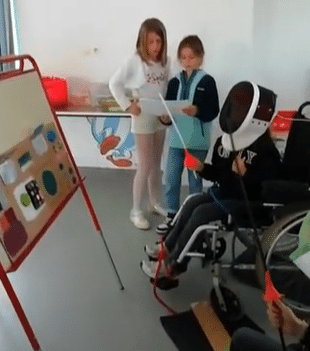
Votre mission: Résistez à la gravité pour marquer le plus de points possible. This resource was created by CNES, ESERO …