
Water in space
In this lesson, we will search for water in the universe. Water is important because without it, life as we know it would not be possible. We have plenty of liquid water on Earth, but the question is whether this is also the case elsewhere in our solar system.
Observing, Predict, Logical Reasoning

Your Mission: Perform an activity that blends together squats, pushups, and jumping in the air (burpees) to promote muscular strength, …
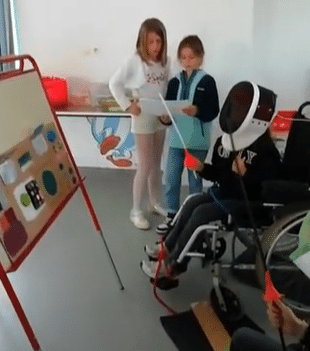
Votre mission: Résistez à la gravité pour marquer le plus de points possible. This resource was created by CNES, ESERO …

Your Mission: Train with a cycle to improve leg muscles, cardio-vascular fitness and endurance. One exercise device that is regularly …

Your Mission: Perform the Commander Crunch and Pilot Plank to improve the strength in abdominal and back muscles. Astronauts in …

Your Mission: Assemble a puzzle quickly and correctly to understand the importance of dexterity and hand-eye coordination. When working with …
Your Mission Playing sports requires teamwork and preparation. Teammates must work together. In space, astronauts also must react to new …
During a spacewalks, astronauts need some serious dexterity and hand-eye coordination to carefully complete tasks, all while wearing bulky gloves …

Your Mission: Identify which plants are suitable for growing in space as a good source of nutrition for astronauts. Food …

Your Mission: Perform body-weight squats and push-ups to develop upper and lower body strength in muscles and bones. Astronauts must …

Your Mission: Follow the development of three plants for 12 weeks to explore germination and plant growth. If astronauts are …