
Water in space
In this lesson, we will search for water in the universe. Water is important because without it, life as we know it would not be possible. We have plenty of liquid water on Earth, but the question is whether this is also the case elsewhere in our solar system.
Observing, Predict, Logical Reasoning
Your Mission: Complete an agility course as quickly and as accurately as possible to improve agility, coordination and speed. When …
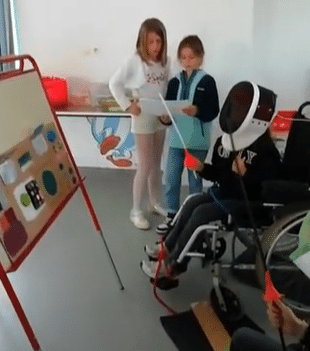
Votre mission: Résistez à la gravité pour marquer le plus de points possible. This resource was created by CNES, ESERO …

Your Mission: Perform a series of somersaults on the ground to improve body coordination, flexibility, balance and strengthen your back, …

Your Mission: Perform an activity that blends together squats, pushups, and jumping in the air (burpees) to promote muscular strength, …

Your Mission: Sample, grow, and investigate the microorganisms around us. Microbiologists have found that microbes can live just about everywhere, …

Your Mission: Perform jump training with a rope to improve strength and endurance. On Earth, humans experience the effects of …
Did you know that jumping might be a key activity in keeping astronauts healthy in space? Try some jump rope …
Your MissionAccumulate a total of 42 km (26.2 mi) as a team, an individual or as a family… it is …

Your Mission: Investigate which factors affect plant growth, and relate these factors to growing plants in space. All the things …

Your Mission: Perform a walk, progressing to 1600m to improve lung, heart, and other muscle endurance. When exploring space, astronauts …